DIY Octopad with Piezo Sensors and a Roland TD-11
A compact, space-saving octopad built from piezo sensors and aluminium-composite triggers, wired into an existing Roland TD-11 module for silent, headphone practice.
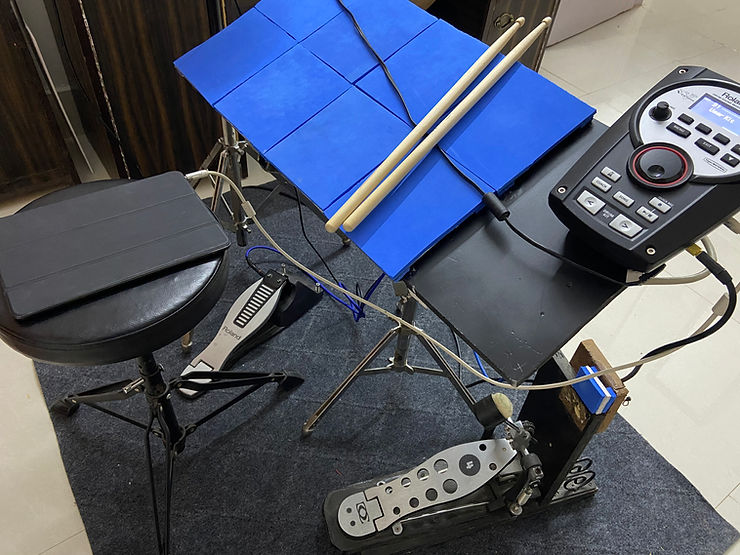
For a drummer with limited space, an octopad is an excellent solution. I already own a Roland TD-11 kit, but after relocating I ran into space constraints. This project combines my existing module with new piezoelectric sensors to make a compact, practice-friendly setup I can use on headphones without disturbing anyone.
Concept
I prefer electronic kits for their versatility: changeable sound banks, flexibility, and studio-quality recording. The TD-11 module already works off triggers from piezo sensors in its original pads. The challenge was to mount external piezo sensors on a platform and interface them with the TD-11 in an ergonomic octopad layout.
Materials used
- Drum module (Roland TD-11)
- DB25 cable for sensor-to-module interfacing
- 20 piezoelectric sensors
- Aluminium composite panels / aluminium sheet (3 x 2 feet)
- Rubber mat (a repurposed yoga mat)
- Rubber-based adhesive
- Plywood / MDF / WPC board (3 x 2 feet)
- Wires and soldering equipment
- 5 RCA sockets
- Drum sticks
- Existing hi-hat and bass/kick pedal (modified with a trigger)
- Hi-hat controller (existing)
- Snare stand to mount the octopad
- Tripod/stand for the hi-hat
- Floor mat
Construction
The build has 8 identical triggers, each 5 inches by 4 inches.
- Trigger assembly: cut matching pieces from the aluminium composite panel and rubber sheet. The rubber is bonded to the ACP with rubber-based adhesive to form the striking surface.
- Isolation pads: from the leftover rubber sheet, I cut 32 small 2cm by 2cm footpads (4 per trigger). These act as resting buffers between triggers and prevent false beats from neighbouring-pad interference.
- Sensor mounting: piezo sensors are bonded to the rear of each trigger plate with rubber-based adhesive.
- Wiring and connection: wires are soldered to each piezo. After mapping the instruments in the TD-11, the connections run through the DB25 socket or are soldered directly.
- Bass-drum pedal: my existing bass pedal is mounted to a spray-painted black WPC base and clamped securely. A piezo sensor sits on a 45-degree 3 inch by 3 inch wooden triangle, connected to an RCA socket.
Originally published on sslabs.in.