DIY 2.1 Home Audio System
A 2.1 sound system built after a proper study of subwoofer acoustics: a ported MDF enclosure sized from Thiele-Small parameters, an NE5532 pre-amp, and a TDA2050 power stage for deep, punchy bass.
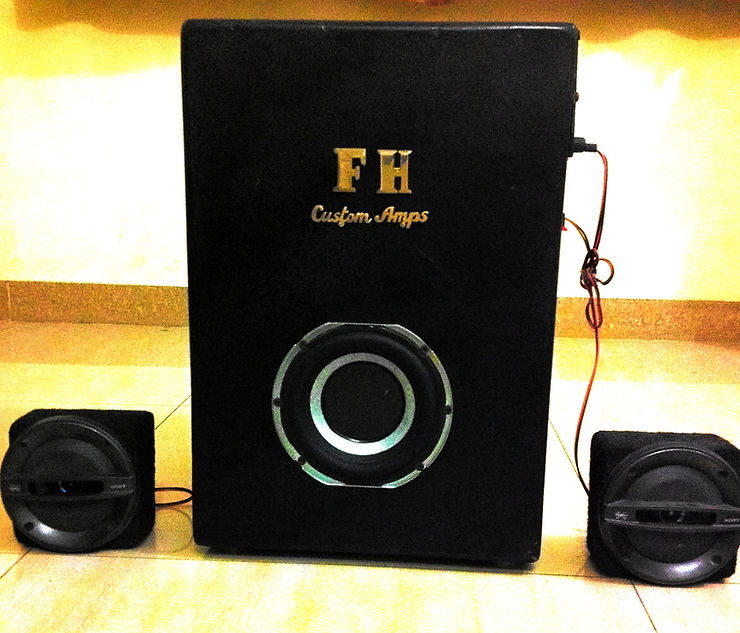
This is another project made after a detailed study of acoustics and the dynamics of the subwoofer. The system is a 2.1 sound system intended for use with a TV, PC, radio, or any multimedia device. The motivation behind making it was the thirst for a system with deep, good bass and ease of access.
Construction materials
19mm MDF boards (for the subwoofer), 1 inch nails, 500g wood glue, basic carpentry tools, one Sony subwoofer (I managed one from a spare-parts store in Lamington Road, Mumbai), two 4 inch speakers (Sony Xplod two-way car speakers), a laser printer for printing the PCB on magazine paper, FeCl3 solution for etching the PCB, a small drill machine for drilling holes in the PCB, and a hand drill.
Construction of the subwoofer enclosure
There were a lot of choices for making the subwoofer enclosure, such as a sealed box, ported box, vented box, dual-port box, and so on. Every enclosure has its pros and cons, so going with the ease of availability of construction materials and entry-level woodworking skills, I decided to go with a ported box.
The first thing required for construction of a subwoofer are the inner measurements. The dimensions of the enclosure are decided by the Thiele-Small parameters of the subwoofer used. My subwoofer was a Sony home theatre, model Davis 10.
Since there was no available data of TS parameters for it, I had to calculate them with the help of a testing jig. The detailed tutorial on finding TS parameters can be found on sound.westhost.com, an excellent resource by Rod Elliott. The software I used for calculating the subwoofer parameters is AJVENT.
Using the TS parameters, the calculated volume of the subwoofer came out to be 55 litres. The equivalent box dimensions for the required volume were 12 x 15 x 18 inches, with a port of 9 inch length and 3 inch diameter.
Construction of the circuit
The circuit required for the 2.1 system needed to be a 3-channel amplifier with bass and volume control. For this I used an existing circuit available on the internet from Mirley Firlej, with some modifications in component values to tune it to my amp. The circuit comprised a complete pre-amp with pre, buffer, control, and gain stages using four NE5532 ICs. The schematic can be found on mirley.firlej.org.
I used a TDA2050 instead of the specified TDA2030 in the above circuit, with the corresponding modifications in component values per the datasheet. The satellite speakers were installed in a normal sealed-box enclosure.
Power supply
The power supply requirement for the circuit, as seen from the TDA2050 datasheet, was a 25-0-25V dual-voltage supply with a current rating of 4 amperes. A four-leg diode was used for the bridge rectifier, and a 25-0-25 centre-tap transformer rated for 4A was ordered from a local shop.
The final system came together with a bit of brass on it, and the bass had a real, deep punch.
Originally published on sslabs.in.